Know Thyself and You Will Know the Universe and the Gods

Ruins of forecourt of the Temple of Apollo at Delphi, where "know thyself" was one time said to be inscribed

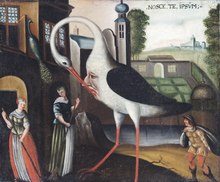
Emblematic painting from the 17th century with text Nosce te ipsum
The Aboriginal Greek aphorism "know thyself" (Greek: γνῶθι σεαυτόν , transliterated: gnōthi seauton ; also ... σαυτόν … sauton with the ε contracted) is i of the Delphic maxims and was the first of three maxims inscribed in the pronaos (forecourt) of the Temple of Apollo at Delphi according to the Greek writer Pausanias (x.24.1).[one] The two maxims that followed "know thyself" were "nothing to excess" and "certainty brings insanity".[2] In Latin the phrase, "know thyself", is given as nosce te ipsum [3] or temet nosce .[4]
The maxim, or aphorism, "know thyself" has had a diversity of meanings attributed to it in literature, and over time, every bit in early on ancient Greek the phrase meant "know thy mensurate".[5]
Attribution [edit]
The Greek aphorism has been attributed to at to the lowest degree the following ancient Greek sages:
- Bias of Priene[half-dozen]
- Chilon of Sparta[7]
- Cleobulus of Lindus[6]
- Heraclitus[8]
- Myson of Chenae[6]
- Periander[ix]
- Pittacus of Mytilene[6]
- Pythagoras[10]
- Plato[11]
- Solon of Athens[6]
- Thales of Miletus[12]
Diogenes Laërtius attributes information technology to Thales (Lives I.xl), simply as well notes that Antisthenes in his Successions of Philosophers attributes it to Phemonoe, a mythical Greek poet, though admitting that it was appropriated past Chilon. In a give-and-take of moderation and cocky-awareness, the Roman poet Juvenal quotes the phrase in Greek and states that the precept descended due east caelo (from heaven) (Satires 11.27). The tenth-century Byzantine encyclopedia the Suda recognized Chilon[7] and Thales[12] equally the sources of the maxim "Know Thyself".
The authenticity of all such attributions is hundred-to-one; according to Parke and Wormell (1956), "The actual authorship of the three maxims prepare up on the Delphian temple may be left uncertain. Most likely they were popular proverbs, which tended later to be attributed to particular sages."[13] [xiv]
Usage [edit]
Listed chronologically:
By Aeschylus [edit]
The ancient Greek playwright Aeschylus uses the maxim "know thyself" in his play Prometheus Bound. The play, about a mythological sequence, thereby places the maxim within the context of Greek mythology. In this play, the demi-god Prometheus first rails at the Olympian gods, and against what he believes to be the injustice of his having been bound to a cliffside past Zeus, king of the Olympian gods. The demi-god Oceanus comes to Prometheus to reason with him, and cautions him that he should "know thyself".[15] In this context, Oceanus is telling Prometheus that he should know amend than to speak ill of the one who decides his fate and accordingly, perhaps he should ameliorate know his place in the "peachy order of things".
Past Socrates [edit]
One of Socrates'south students, the historian Xenophon, described some of the instances of Socrates'southward use of the Delphic saying "Know Thyself" in his history titled: Memorabilia. In this writing, Xenophon portrayed his teacher's apply of the maxim as an organizing theme for Socrates's lengthy dialogue with Euthydemus.[16]
Past Plato [edit]
Plato, another student of Socrates, employs the saying "Know Thyself" extensively by having the character of Socrates use it to motivate his dialogues. Benjamin Jowett's index to his translation of the Dialogues of Plato lists vi dialogues which discuss or explore the Delphic maxim: "know thyself". These dialogues (and the Stephanus numbers indexing the pages where these discussions begin) are Charmides (164D), Protagoras (343B), Phaedrus (229E), Philebus (48C), Laws (II.923A), Alcibiades I (124A, 129A, 132C).[17]
In Plato'south Charmides, Critias argues that "succeeding sages who added 'never too much', or, 'give a pledge, and evil is nigh at hand', would announced to have so misunderstood them; for they imagined that 'know thyself!' was a piece of advice which the god gave, and non his salutation of the worshippers at their outset coming in; and they defended their own inscription under the idea that they too would give as useful pieces of communication."[eighteen] In Critias' opinion "know thyself!" was an admonition to those entering the sacred temple to call back or know their place and that "know thyself!" and "exist temperate!" are the same.[19] In the balance of the Charmides, Plato has Socrates pb a longer research as to how nosotros may gain cognition of ourselves.
In Plato's Phaedrus, Socrates uses the maxim "know thyself" as his explanation to Phaedrus to explain why he has no time for the attempts to rationally explain mythology or other far flung topics. Socrates says, "But I have no leisure for them at all; and the reason, my friend, is this: I am not withal able, as the Delphic inscription has it, to know myself; so it seems to me ridiculous, when I practise not yet know that, to investigate irrelevant things."[twenty]
In Plato's Protagoras, Socrates lauds the authors of pithy and concise sayings delivered precisely at the right moment and says that Lacedaemon, or Sparta, educates its people to that terminate. Socrates lists the Seven Sages as Thales, Pittacus, Bias, Solon, Cleobulus, Myson, and Chilon, who he says are gifted in that Lacedaemonian fine art of curtailed words "twisted together, similar a bowstring, where a slight effort gives great strength".[21] Socrates says examples of them are, "the far-famed inscriptions, which are in all men's mouths—'Know thyself', and 'Nothing too much'".[22] Having lauded the maxims, Socrates then spends a great deal of fourth dimension getting to the bottom of what one of them ways, the saying of Pittacus, "Hard is it to be good." The irony here is that although the sayings of Delphi bear "smashing force", it is non clear how to live life in accordance with their meanings. Although, the concise and wide nature of the sayings suggests the active partaking in the usage and personal discovery of each saying; every bit if the intended nature of the saying lay not in the words merely the cocky-reflection and self-referencing of the person thereof.
In Plato's Philebus dialogue, Socrates refers dorsum to the same usage of "know thyself" from Phaedrus to build an example of the ridiculous for Protarchus. Socrates says, as he did in Phaedrus, that people make themselves appear ridiculous when they are trying to know obscure things before they know themselves.[23] Plato likewise alluded to the fact that agreement "thyself" would have a greater yielded gene of agreement the nature of a human being. Syllogistically, agreement oneself would enable thyself to have an understanding of others every bit a result.
Later usage [edit]
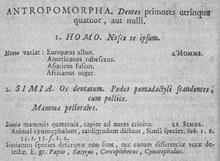
Detail from the 6th edition of Linnaeus' Systema Naturae (1748). "HOMO. Nosce te ipsum."
The Suda, a 10th-century encyclopedia of Greek knowledge, states: "the saying is applied to those whose boasts exceed what they are",[7] and that "know thyself" is a alert to pay no attention to the opinion of the multitude.[24]
Cocky-noesis was an of import concept in the writings of the 12-13th century Castilian Sufi Ibn Arabi. He distinguished between various philosophical and mystical meanings of "Know Thyself" and the hadith "Who knows himself, knows his Lord."[25]
One work by the Medieval philosopher Peter Abelard is titled Scito te ipsum ("know yourself") or Ethica.
From 1539 onward, the phrase nosce te ipsum and its Latin variants were used in the anonymous texts written for anatomical fugitive sheets printed in Venice as well as for after anatomical atlases printed throughout Europe. The 1530s fugitive sheets are the first instances in which the phrase was applied to knowledge of the human body attained through autopsy.[26]
In 1600, in his play Village, Shakespeare writes, "To thine own self exist true."
In 1651, Thomas Hobbes used the term nosce teipsum which he translated as "read thyself" in his work The Leviathan. He was responding to a popular philosophy at the time that you can larn more by studying others than yous tin from reading books. He asserts that i learns more by studying oneself: particularly the feelings that influence our thoughts and motivate our actions. As Hobbes states, "but to teach us that for the similitude of the thoughts and passions of one homo, to the thoughts and passions of another, whosoever looketh into himself and considereth what he doth when he does think, opine, reason, hope, fearfulness, etc., and upon what grounds; he shall thereby read and know what are the thoughts and passions of all other men upon the similar occasions."[27]
In 1734, Alexander Pope wrote a poem entitled "An Essay on Human being, Epistle II", which begins "Know then thyself, presume not God to scan, The proper study of mankind is Man."[28]
In 1735, Carl Linnaeus published the first edition of Systema Naturae in which he described humans (Homo) with the unproblematic phrase "Nosce te ipsum".[29]
In 1750, Benjamin Franklin, in his Poor Richard'due south Almanack, observed the great difficulty of knowing one'south self, with: "There are three Things extremely hard, Steel, a Diamond, and to know 1'south self."[30]
In 1754, Jean-Jacques Rousseau lauded the "inscription of the Temple at Delphi" in his Discourse on the Origin of Inequality.
In 1831, Ralph Waldo Emerson wrote a verse form titled "Γνώθι Σεαυτόν", or Gnothi Seauton ('Know Thyself'), on the theme of "God in thee". The verse form was an canticle to Emerson's belief that to "know thyself" meant knowing the God that Emerson felt existed inside each person.[31]
In 1832, Samuel T. Coleridge wrote a poem titled "Self Noesis" in which the text centers on the Delphic maxim "Know Thyself" beginning "Gnôthi seauton!—and is this the prime And heaven-sprung aphorism of the olden fourth dimension!—" and ending with "Ignore thyself, and strive to know thy God!" Coleridge'southward text references JUVENAL, eleven. 27.[32]
In 1857, Allan Kardec asks in The Spirits Volume (question 919): "What is the well-nigh effective method for guaranteeing self-improvement and resisting the attraction of wrongdoing?" and obtains the answer from the Spirits "A philosopher of artifact once said, 'Know thyself'".[33] Acknowledging the wisdom of the maxim, he so asks virtually the means of acquiring cocky-knowledge, obtaining a detailed respond with applied instructions and philosophical-moral considerations.
In 1902, Hugo von Hofmannsthal had his 16th-century modify ego in his letter to Francis Bacon mention a volume he intended to call Nosce te ipsum.
In 1978 Idries Shah wrote in Learning How to Learn, p. 38, "People have to know more about themselves earlier they take on what are so often misconceived projects." In 1997 he explained "Know Thyself" thus in The Commanding Self, p. 15, "'He who knows himself, knows his Lord' means, among other things, that cocky-charade prevents knowledge... The starting time self about which to obtain knowledge is the secondary, false self which stands in the fashion..." The theme of knowing oneself and knowing God is also featured in the above citations from Ibn Arabi, Pope, Coleridge and Emerson, in different ways.
The Wachowskis used one of the Latin versions (temet nosce) of this aphorism as inscription over the Oracle'southward kitchen doorway in their movies The Matrix (1999)[34] and The Matrix Revolutions (2003).[35] The transgender graphic symbol Nomi in the Netflix show Sense8, once more directed by The Wachowskis, has a tattoo on her arm with the Greek version of this phrase.
"Know Thyself" is the motto of Hamilton College of Lyceum International School (Nugegoda, Sri Lanka) and of İpek University (Ankara, Turkey).[36] The Latin phrase "Nosce te ipsum" is the motto of Landmark Higher.
Nosce te ipsum is likewise the motto for the Scottish clan Thompson. It is featured on the family crest or coat of arms.[37]
In other cultures [edit]
Knowing the Self is a cadre principle towards spiritual liberation or Moksha in Indian philosophical traditions, including Advaita Vedanta. In the Upanishads, it appears equally "Atmanam Viddhi", that literally translates to "know thyself". The thought is reflected through the four cardinal statements known as Mahavakya, found in the 4 Vedas, which form the foundations of Vedanta philosophy.
In The Art of War, the maxim 知彼知己,百战不殆 means "know others and know thyself, and you will not exist endangered by innumerable battles". In this proverb past Lord's day Zi (孙子, Sun Tze), the thought of knowing oneself is paramount.
Encounter also [edit]
- Delphic maxims
- I know that I know nada
- Introspection
- Jnana
- Philosophy of cocky
- Cocky-knowledge (psychology)
- The Fine art of State of war
- Mahāvākyas
References [edit]
- ^ "Pausanias, Description of Hellenic republic, Phocis and Ozolian Locri, chapter 24". www.perseus.tufts.edu.
- ^ Plato Charmides 165
- ^ "Nosce te ipsum - Definition and More from the Free Merriam-Webster Dictionary". Merriam-webster.com. 2010-08-13. Retrieved 16 March 2011.
- ^ "AllExperts.com: temet nosce". allexperts.com. Archived from the original on 31 December 2011. Retrieved 17 February 2013.
- ^ Wilkins, Eliza Thousand. (April 1927). "ΕΓΓΥΑ, ΠΑΡΑ ΔΑΤΗ in Literature" (PDF). Classical Philology. University of Chicago Press. 22 (2): 121–135. doi:10.1086/360881. JSTOR 263511. S2CID 162666822.
- ^ a b c d e "Plato, Protagoras, section 343a". world wide web.perseus.tufts.edu.
- ^ a b c "SOL Search". www.cs.uky.edu.
- ^ Doctoral thesis, "Know Thyself in Greek and Latin Literature," Eliza G. Wilkens, U. Chi, 1917, p. 12 (online).
- ^ Pausanias 10.24.1 mentions a controversy over whether Periander should exist listed as the seventh sage instead of Myson. Only Socrates who is cited by Pausanias as his source supports Myson. Paus. 10.24
- ^ Vico, Giambattista; Visconti, Gian Galeazzo (1993). On humanistic education: (six inaugural orations, 1699-1707) . Half dozen Inaugural Orations, 1699-1707 From the Definitive Latin Text, Introduction, and Notes of Gian Galeazzo Visconti. Cornell University Press. p. 4. ISBN0801480876.
- ^ "Plato, Philebus, section 48c". www.perseus.tufts.edu.
- ^ a b "SOL Search". www.cs.uky.edu.
- ^ H. Parke and D. Wormell, The Delphic Oracle, (Basil Blackwell, 1956), vol. 1, p. 389.
- ^ Dempsey, T., Delphic Oracle: Its Early History, Influence & Fall, Oxford: B.H. Blackwell, 1918. With a prefatory notation past R. South. Conway. Cf. pp.141-142 (Alternative source for book at Internet Archive in various formats)
- ^ Aeschylus, Prometheys Bound, v. 309: γίγνωσκε σαυτὸν.
- ^ "Xenophon, Memorabilia, Book 4, chapter 2, department 24". www.perseus.tufts.edu.
- ^ Plato, The Dialogues of Plato translated into English with Analyses and Introductions past Benjamin Jowett, M.A. in Five Volumes. 3rd edition revised and corrected (Oxford Academy Press, 1892), (See Index: Cognition; 'know thyself' at Delphi).
- ^ "Plato, Charmides, section 165a". www.perseus.tufts.edu.
- ^ "Plato, Charmides, section 164e". world wide web.perseus.tufts.edu.
- ^ "Plato, Phaedrus, section 229e". www.perseus.tufts.edu.
- ^ "Plato, Protagoras, department 343a". www.perseus.tufts.edu.
- ^ "Plato, Protagoras, department 343b". www.perseus.tufts.edu.
- ^ "Plato, Philebus, section 48c". www.perseus.tufts.edu.
- ^ "SOL Search". www.cs.uky.edu.
- ^ Know Yourself, According To Qur'an And Sunnah: Ibn Arabi's View, Journal of Philosophical Theological Enquiry Autumn 2007, Volume ix, Number 1 (33); Page(s) 6 to 22, https://www.sid.ir/en/periodical/ViewPaper.aspx?FID=105220073301
- ^ William Schupbach, The Paradox of Rembrandt's "Beefcake of Dr. Tulp" (Wellcome Institute for the History of Medicine: London, 1982), pp. 67–68
- ^ Hobbes, Thomas. "The Leviathan". Ceremonious peace and social unity through perfect government. Oregon State Academy: Phl 302, Great Voyages: the History of Western Philosophy from 1492–1776, Winter 1997. Archived from the original on 27 November 2010. Retrieved half-dozen January 2011.
- ^ "Alexander Pope begins his Essay on Man Epistle II 'Know then thyself'".
- ^ Maxwell, Mary (January 1984). Human Evolution: A Philosophical Anthropology. ISBN9780709917922.
- ^ Franklin, Benjamin (Jan 31, 1904). "Autobiography: Poor Richard. Letters". D. Appleton – via Google Books.
- ^ "Emerson -Verse- Gnothi Seauton". archive.vcu.edu.
- ^ Samuel T. Coleridge wrote the poem "Self Knowledge" discussing Gnôthi seauton or know thyself.
- ^ "O Livro dos Espíritos > Parte terceira — Das leis morais > Capítulo XII — Da perfeição moral > Conhecimento de si mesmo". kardecpedia.com.
- ^ See occurrences on Google Books.
- ^ McGrath, Patrick (10 January 2011). "'Know Thyself'. The most important art lesson of all". patrickmcgrath . Retrieved 3 Oct 2013.
- ^ ipek.edu.tr.
- ^ "Thompson Surname, Family unit Crest & Coats of Arms". Business firm of Names . Retrieved xix Apr 2017.
External links [edit]
- Gnothi sauton at Binghamton University
- "The Examined Life", BBC Radio 4 word with A.C. Grayling, Janet Radcliffe & Julian Baggini (In Our Time, May ix, 2002)
Source: https://en.wikipedia.org/wiki/Know_thyself
0 Response to "Know Thyself and You Will Know the Universe and the Gods"
Postar um comentário