It Was Only the Darkened House That Could Contain Her When Sunshine Came Again She Was Not There
The firefighter lay unconscious in the frontyard of the burning home. His crew pulled off his soot-covered equipment and started CPR, pumping down difficult with their hands on his chest, over and again.
The ambulance was more than five minutes abroad.
From beyond Tarapaca Route in Rancho Palos Verdes, Tim Racisz watched as flames devoured his home. A neighbor counted the chest compressions — hundreds it seemed — beingness performed on the fallen firefighter.
"This is hopeless," the neighbor, a medico, told Racisz every bit fume billowed. "Yous tin can't give somebody that many compressions without but destroying them. They're not going to come back."

The fire in the 30700 block of Tarapaca Road in Rancho Palos Verdes on Jan. 6.
(Timothy Racisz)
Jonathan Flagler, a 21-year veteran fire fighter, never came back. The coroner later establish that the father of two had suffocated. The tank in his breathing apparatus had run out of air.
Even in a place as vast and flammable every bit Los Angeles, Flagler'due south demise represents something rare: the decease of an urban fire-eater battling a construction fire.
Over the concluding iii decades, 14 members of the L.A. Canton Fire Section accept died while on duty, according to data kept by the U.S. Burn Administration. Just three of those firefighters, including Flagler, were battling construction fires.
In a confidential report obtained past The Times, Burn Department investigators reconstructed what happened in the pre-dawn hours of January. half dozen. Relying on interviews with firefighters on the scene that dark, deputies' torso-worn cameras, recordings of radio transmissions and an test of Flagler'due south protective equipment, they stitched together a minute-past-infinitesimal accounting of how the tragedy unfolded from the moment Racisz's wife reported fume in their four-bedroom habitation to the call of a "firefighter down."

(Flagler family)
The report does non proper noun the firefighters involved. But, combined with Racisz's recollections, it exposes failures that price Flagler his life. Firefighters underestimated the extent of the fire. A firefighter was left unaccounted for in a burning habitation. Fire crews missed a mayday phone call.
As the Fire Department searches for answers, so too does Flagler's family. His death, his wife said at a memorial service, leaves a "hole in my eye that will never fully heal."
"All information technology took was 1 date, and I knew he was the homo I was meant to spend the rest of my life with," Jenny Flagler said. "I didn't get the rest of my life, but I got the residual of his."
Every bit Jonathan Flagler got dressed to leave his San Clemente home on Jan. v at 5 a.m., his wife asked him to call in sick.
The couple had been suffering from congestion, a cough and fatigue. Neither one knew at the time that they had COVID-xix.
"I'm fine, infant, I'm going to be OK," Flagler reassured his wife. "I'm only going to be gone one day, and and so I'll come up habitation."
So he collection more than than sixty miles to Fire Station 83, where he'd been employed for a year. Working there felt nostalgic for the 47-year-former. The station was where he'd participated in the Explorer Programme, which introduces teenagers and young adults to careers in the fire service.

Subscribers become early access to this story
Jenny didn't worry when Jonathan headed in that location for a shift. She was concerned, she said, only when he went out on wildland fires. Those felt more than unpredictable and dangerous. She'd go hours without hearing from him.
Jonathan was busy that Wednesday at the station, but able to text Jenny a couple of times. That evening, equally usual, he called his wife to recap the day. The conversation was shorter than normal.
"Nosotros've been running calls all mean solar day. I'm tired," Jonathan said. "I'm hoping we don't have whatsoever calls tonight and I tin can go some sleep."
His shift wasn't scheduled to end until the next forenoon, around 8.
"I hope you can get some remainder," Jenny said earlier they hung up. "I'll see you lot in the morning."
Racisz and his married woman smelled the acrid fume before they saw the fire.
He was asleep in the bedroom while his wife watched TV in another room. As she got ready to become to bed, she caught a called-for scent wafting through the more than two,000-square-pes house on January. 6. Before long after, the fume alarm woke him.
Racisz, who had lived in the wood-frame and stucco home off and on for more than xl years, began to search the familiar rooms for the source of the smell. There wasn't much more fume than there'd be if you burned something in the kitchen, he said, but the awful stench seemed to permeate the house.
His search came up empty.
Racisz, 63, got dressed as his wife called 911. At two:01 a.k., the Los Angeles Communications Eye dispatched engine companies to Tarapaca Road with a text that read: "FIRE IN Cranium, SMK CHARGING ROOM".

Dispatch records show how Los Angeles firefighters tried to contain a called-for firm in Rancho Palos Verdes.
Racisz grabbed his wallet and glasses; his married woman took an iPad and portfolio. They raced out, leaving the front doors open up, and stood by their ivy-covered garage. Racisz couldn't see whatever fume through the darkness.
Within minutes, a truck arrived from Station 83, less than 2 miles away, along with sheriff's deputies. A helm from the station, engineer, patrol fire-eater and Flagler went inside to investigate and plant a small burn around the back of an finish tabular array in the master bedroom. The patrol firewoman used a two.5-gallon water extinguisher to douse the flames.
Flagler checked the wall and ceiling temperatures in the room with a thermal imaging camera. But he didn't know that the room's wainscoting and blow-in insulation reduced the camera's effectiveness.
He reported no significant findings.
Around ii:10 a.m., the fire helm radioed the dispatch center to written report that his team had encountered a small burn. He said they would be able to handle it with i other crew already en route. Several units were canceled.
Flagler grabbed his animate appliance from the engine, pressurized it and put on his face slice before going dorsum into the house. The fire engineer soon followed suit.
They didn't feel the heat of a burn in the master sleeping room. But when turning the lights on, they saw smoke gathering forth the ceiling. They opened a sliding glass door to ventilate the room and moved the California king bed to clear a path.
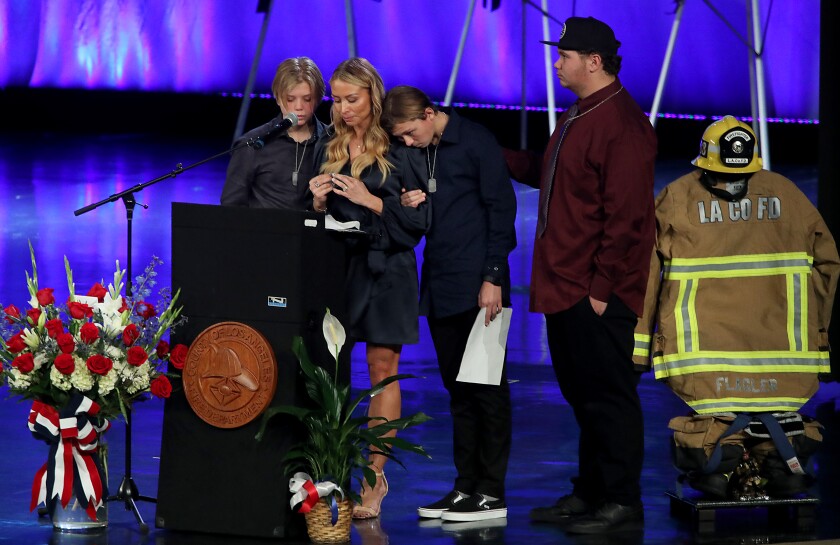
Jenny Flagler is flanked past her sons, Brody, left, and Jack, and nephew Matix Hernandez, correct, while speaking at a memorial service for her hubby, Los Angeles Canton firefighter Jonathan Flagler, who was killed in the line of duty.
(Luis Sinco / Los Angeles Times)
Racisz watched as 1 of the coiffure members exited the house with the smoldering nightstand. The couple was told it had been pinpointed as the source of the fire.
"We'll prove up with some fans and accident the smoke out," Racisz recalled being told. "Things are under control."
But Racisz hadn't seen the nightstand on fire every bit the house filled with the smell of smoke and he and his wife raced to condom. It wasn't the cause, he said, merely the event.
Soon after, inside the bedroom, the engineer spotted crusade for concern: charring on the v-foot-high ash wainscoting near an electrical outlet that could signal the fire had spread.
When a camera showed no significant thermal readings, Flagler left to grab an ax. On the front porch, he told his captain that he was going to use to the tool to check for fire in the wall.
Flagler repeatedly struck the wainscoting with the ax, finally succeeding in creating a small hole near the outlet. Inside, the coiffure spotted a flame licking at the base of the wall. The patrol firefighter exhausted the 2.5-gallon h2o extinguisher trying to put information technology out.
Soon, dark smoke began to spread through the business firm. Recognizing that they needed more than water to douse the blaze, the engineer and patrol firefighter left to go a hose.
Flagler stayed behind.
Three couples huddled together beyond the street from the called-for house.
Deputies had moved Racisz and his wife there, away from the garage. Neighbors from two houses to the southward also were evacuated, for fear that the fire could spread.
"50.A., Engine 83, can you outset the full assignment over again?" the fire captain called over the radio at 2:23 a.g., his breathing heavy. He indicated that the engine companies that had been turned dorsum should render to the scene of the blaze. "I do have a burn down in the cranium."

A fire-destroyed home in the 30700 block of Tarapaca Route in Rancho Palos Verdes.
(Timothy Racisz)
Nearby, the patrol fire-eater from Flagler'southward station tried to pull a hose toward the master chamber. Heavy flames blocked his way. Meanwhile, the crew engineer dragged a hose toward the side of the house, where there was a visible glow.
Twenty-five minutes after the Raciszes chosen 911, a crew arrived from Burn down Station 106. Crew members spotted flames climbing through the roof. Soon after, the blaze shattered a window.
So, the alarm on Flagler's breathing apparatus went off, warning him that he was low on air. By that time, he had been alone in the house for most 10 minutes.
Exterior, the Engine 83 engineer pulled a hose uphill toward the nearest fire hydrant. A captain and fireman paramedic sprayed h2o through the rear sliding door and window openings.
Inside, Flagler depressed and held a cherry button on his breathing appliance to activate an alarm. Lights on the apparatus flashed red, and alert tones sounded from its front and rear mounted speakers.
But at that place was no 1 else in the burning building to hear them.
It was ii:31 a.thousand.
A infinitesimal subsequently, Flagler activated the emergency trigger on his radio and transmitted a mayday, alerting others that he was low on air. The corner of the house near the chief bedroom was engulfed in flames.
Outside, the Engine 83 captain, Flagler's commanding officeholder, was on the radio. He told dispatch: "If you haven't started an ambulance, start ane."
He was the man tasked with his crew'southward safety.
And he couldn't hear Flagler's cry for help.
Nearly a mile away, a hi-lo warble tone sounded inside Engine 56, indicating there was a fire fighter in distress at the scene on Tarapaca Road. The truck's captain tried to go through to the captain from Engine 83, but couldn't.
As the Engine 53 fire crew navigated switchbacks on Palos Verdes Bulldoze East, where signs urged speeds of no more than 20 mph, they as well heard the emergency signal. But they were still five minutes abroad.
At the burning domicile, the Station 106 helm heard the warble tone and looked around for his coiffure, counting heads, making sure everyone was safe. The fireman paramedic from 106 saw Flagler's emergency alarm and told the captain that at that place was a man in problem.
The report does not specify what was said. But instead of turning his attending to rescuing Flagler, the captain kept battling the burn down at the back of the firm.
The firewoman paramedic ran to Engine 83 to tell that helm that Flagler was low on air and the alarm had not been set off by blow.
The Engine 83 patrol fire fighter — who had been in the house with Flagler but left the building — asked some other crew member where Flagler was.
No one knew.
Flagler had sought shelter in a minor bathroom off the hallway. His ax rested outside the door.
When the Engine 53 captain constitute him, the warning on his animate appliance was sounding. His flashlight and thermal imaging camera were on. He was out of air, unconscious and, every bit the study described him, "apneic," having temporarily stopped breathing.
The Engine 53 captain yelled for his firewoman to help him. The two moved Flagler down the hall, pulling him by the shoulder straps on his animate apparatus. The Engine 56 helm soon joined them and helped carry the downed firefighter out the front door.
At ii:42 a.k., the coiffure removed Flagler's equipment and began CPR. Racisz watched in daze from across the street.
"Nosotros take a firefighter down," the helm from Engine 83 said over the radio. He asked when the ambulance would arrive.
At 2:54 a.m., Flagler was loaded onto a gurney and into the ambulance. He had 3rd-degree burns over 16% of his body and broken ribs from the frantic efforts to revive him through CPR. He arrived at Harbor-UCLA Medical Center 18 minutes afterwards.
He was pronounced dead at iii:26 a.grand.
When the doorbell rang around 5 a.m., startling Jenny awake, her beginning instinct was to call her husband. Then it rang again. And again.
The people outside told her through the door that they were with L.A. County. Confused, Jenny wondered if there was a fire in her backyard or possibly a water leak. When she opened the door, she said, the news was axiomatic on their faces.
She crumpled to the footing. All that moved her were the screams and cries of her two teenage sons, who had overheard the terrible news. She ran upstairs to hold them. The three savage to the basis crying.
"No, Mom, not Dad," one son said. "Please don't let it exist Dad."
The following days passed in a blur. At Flagler'southward memorial service on Jan. 21, friends, family and fellow firefighters shared stories.
To Jack, 13, Flagler was the type of father who kept Jolly Rancher candy in his truck and in his pocket to pass out to his friends, earning him the nickname "Uncle Jolly." To Brody, he was the type of dad to trade shifts with work buddies then he could sentinel football game with his fifteen-year-old son every Sunday.

Photo of the Flagler family. From left, Jack, xiii, Jonathan, Jenny and Brody, xv. Los Angeles County fireman Jonathan Flagler lost his life battling a residential burn in Rancho Palos Verdes.
(Jamie Brinkman)
To Jenny, his wife of nearly xix years, Flagler was her soul mate. She considered herself "one of the lucky few that institute him on the beginning try."
As the service neared its finish, Dave Gillotte, the International Assn. of Fire Fighters Local 1014 spousal relationship president and a fire captain, said Flagler "selflessly and bravely did his task well."
"John's legacy will deport lessons learned for his brothers and sisters," Gillotte said.
Those lessons were painstakingly detailed in the internal report, known as a "green sheet."
Flagged in the study were mobile radio programming bug that could cause personnel to miss emergency activations. The need for captains to be answerable over crews in the field. And having firefighters stay in teams of two or more in case of an emergency.
"Flagler was alone in an [immediately dangerous to life or health] surroundings after the remainder of the crew exited the structure," the report stated. "'Two-In, Two-Out' dominion procedures, including operating in teams of 2 or more than, shall be implemented at emergency incidents where [immediately dangerous to life or health] weather exist."
Investigators found there was never a full assessment of the house'south exterior or a thorough investigation of the interior, which could have helped firefighters understand the extent of the burn down.
The report institute that the fire was acquired past an electric malfunction in the wall separating the master bedroom and laundry room. The fire smoldered in the wall until it burned through the plastic electrical outlet cover in the master bedroom. Information technology and so spread into the cranium space and into the room, where it ignited materials around the rear of an end table.
"Personnel conducting initial investigations shall thoroughly check for and dominion out all potential sources of fire before cancelling resources," the report stated. "The readily apparent fire may not fully indicate the extent of burn."
The burn down spread out of the wall infinite and throughout the business firm, "due to construction anomalies, a significant fuel load, and natural ventilation resulting from open front double doors, an opened sliding glass bedroom door, and holes created in the wall," the report said. Investigators recommended more grooming on burn dynamics, live fire and personnel accountability.
Curt Floyd, responder technical lead for the National Fire Protection Assn., does not annotate on specific cases, but he noted that fire fighter deaths accept dropped over the years due to a number of factors. Among them are improved training and education and increased quality of protective equipment.
"We used to run into fire fighter fatalities in the 100s not too long ago and those have dropped downwardly," Floyd said. "Unfortunately, it is a dangerous chore and sometimes you merely don't know what you lot're getting into until you become there."
Flagler'southward family plans to file a lawsuit over his expiry on the job, co-ordinate to an attorney representing the family unit. The defendants in the lawsuit have yet to exist determined. The chaser declined to comment on the report.
Chad Sourbeer, a fire battalion primary, said in a argument that the department is "unable to annotate on the circumstances of the Tarapaca incident due to anticipated litigation."
Simply since the fire, Sourbeer said, every chief in the department has gone through training to reinforce policies and procedures and look for new opportunities to meliorate emergency operations. He added that there is a programme in place departmentwide for the next six months "to take those lessons and reinforce our policies and procedures with our membership."
"The department continues to exist committed to thorough reviews of major incidents, as they are an integral component in assessing how to ameliorate emergency operations and provide better service," Sourbeer said.
In an interview with The Times, Jenny Flagler said she doesn't want her husband's decease to be in vain.
"What we're going through is atrocious," she said. "If I can protect any other family from having to go through this, I'm going to do everything I tin can."
And that, she said, is how she plans to award her husband.
Source: https://www.latimes.com/california/story/2022-05-12/firefighter-down-what-went-wrong
0 Response to "It Was Only the Darkened House That Could Contain Her When Sunshine Came Again She Was Not There"
Postar um comentário