Switching From Family Plan to Individual Plan Sprint
In the this article Dave West, CEO of Scrum.org, outlines the sprint planning ceremony as it's described at Scrum.org. Scrum.org teaches scrum according to the Scrum Guide, which is considered the official guide for the scrum framework among the agile world. Below Megan Cook of Atlassian shares her perspective on dart planning in this video:

What is sprint planning?
Sprint planning is an outcome in scrum that kicks off the sprint. The purpose of sprint planning is to define what tin can be delivered in the sprint and how that work will be achieved. Sprint planning is done in collaboration with the whole scrum team.
In scrum, the sprint is a set up period of time where all the piece of work is done. Nonetheless, before you tin can leap into action you have to prepare the dart. You demand to decide on how long the fourth dimension box is going to be, the sprint goal, and where yous're going to start. The dart planning session kicks off the sprint past setting the agenda and focus. If washed correctly, it also creates an surround where the team is motivated, challenged, and can be successful. Bad dart plans can derail the squad past setting unrealistic expectations.
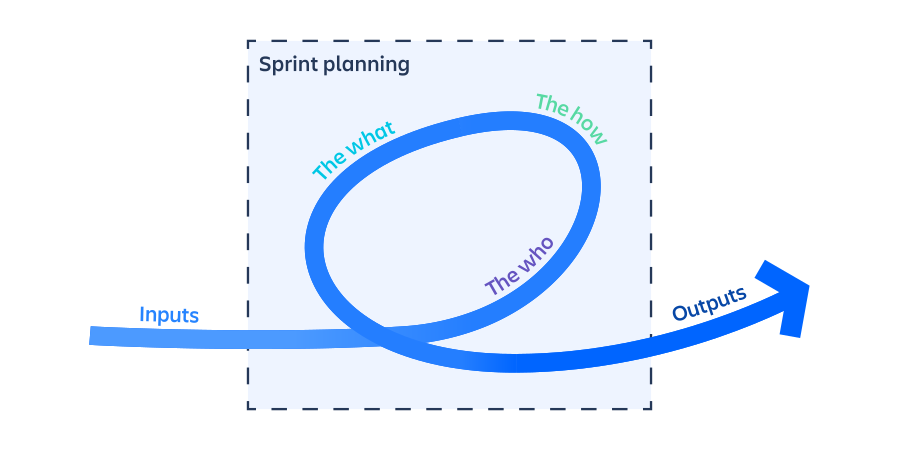
- The What – The production possessor describes the objective(or goal) of the sprint and what excess items contribute to that goal. The scrum team decides what can be done in the coming sprint and what they volition practise during the dart to make that happen.
- The How – The development squad plans the work necessary to deliver the sprint goal. Ultimately, the resulting sprint plan is a negotiation between the development team and product owner based on value and effort.
- The Who – Y'all cannot exercise sprint planning without the product possessor or the development team. The product owner defines the goal based on the value that they seek. The evolution team needs to understand how they tin can or cannot deliver that goal. If either is missing from this event it makes planning the sprint most impossible.
- The Inputs – A keen starting betoken for the sprint plan is the product backlog as it provides a list of 'stuff' that could potentially be office of the electric current dart. The team should also look at the existing piece of work done in the increment and have a view to capacity.
- The Outputs – The most important outcome for the sprint planning meeting is that the team can describe the goal of the sprint and how it will commencement working toward that goal. This is made visible in the sprint backlog.
Prep for sprint planning meeting
Running a great sprint planning outcome requires a bit of field of study. The production owner must be prepared, combining the lessons from the previous sprint review, stakeholder feedback, and vision for the product, and then they set the scene for the sprint. For transparency, the production backlog should be upwardly-to-date and refined to provide clarity. Excess refinement is an optional issue in scrum, considering some backlogs don't need information technology. However, for near teams, it'south better to go the team together to review and refine the backlog prior to sprint planning.
Pro Tip:
If you have a 2-week sprint, run a backlog refinement meeting in the middle of the sprint. It'due south smashing for the team to step dorsum from the sprint and look at what's next. Non simply does information technology help prepare for dart planning, just also tin can give a different perspective for the current work.
Setting a time limit for sprint planning
Sprint planning should be constrained no more than two hours for each week of the sprint. So, for instance, the dart planning coming together for a 2-week sprint would be no longer than four hours. This is chosen "timeboxing", or setting a maximum amount of time for the squad to accomplish a job, in this case, planning the sprint. The scrum master is responsible for making sure the meeting happens the timebox is understood. If the squad is happy before the timebox is finished, then the result is over. A timebox is a maximum time allowed; there is no minimum time allowed.
Focus on the outcomes, not the work
During sprint planning information technology is easy to become 'bogged downward' in the work focusing on which task should come first, who should do information technology, and how long will it take. For complex work, the level of data you know at the start tin exist low, and much of it is based on assumptions. Scrum is an empirical process, meaning that you tin can't programme upfront, only rather larn by doing, and so feed that information back into the process.
The dart goal describes the objective of the sprint at a loftier level, but the excess Items tin can also be written with an event in mind. User stories are ane great way of describing the piece of work from a customer signal of view. User stories, written like the one below, re-focus defects, bug, and improvements on the outcome the customer is seeking rather than the observed problem.
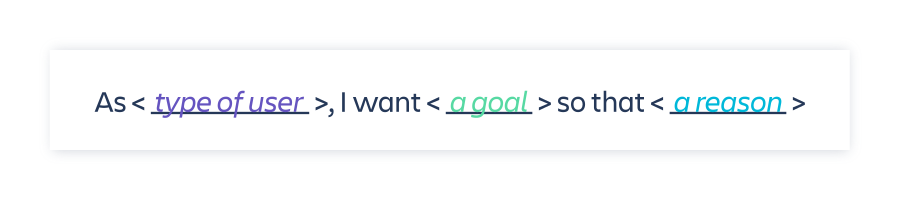
Past calculation articulate, measurable results to the user story, the outcomes can be clearly measured, and you know when you are washed. By getting equally much up-front end clarity as possible on the piece of work the team is focusing on, everyone gets the transparency needed to get started on the piece of work. For example, leaving things vague is much worse than describing something as a question to be answered during the sprint.
Pro Tip:
Not knowing something is unlike from being vague. Don't ignore the unknowns, they are the reality of doing difficult work. But don't hide them past using vague words. Instead, exist articulate when y'all don't know something and frame the work in terms of gaining an understanding.
Estimates are required only don't pretend you know more you practice
Sprint planning requires some level of estimation. The team needs to define what can or cannot exist washed in the sprint: estimated effort vs capacity. Estimation is often confused with commitments. Estimates are by their very nature forecasts based on the knowledge at hand. Techniques such as story points or t-shirt sizing add value to the process by giving the squad a different way of looking at the problem. They are not, however, magical tools that can find out the truth when there is none to be found. The more unknowns, the less likely the estimate will be correct.
Skilful interpretation requires a trust-based surroundings where information is given freely, and assumptions are discussed in the pursuit of learning and improvement. If estimates are used in a negative, confrontational style later on the piece of work is completed, then it's probable that future estimates will be either be much bigger to ensure they never are wrong over again or the time taken to create them will be much longer as the squad 2d guesses itself worrying about the implications of getting them incorrect.
Pro Tip
Explore using different estimation techniques such every bit t-shirt sizing or story points. Different techniques might provide unlike views of the problem.

Sprint planning best practices
Information technology is easy to get so bogged downwards in the details of sprint planning you forget that the focus of dart planning is to build a 'only enough' program for the side by side sprint. That plan shouldn't become a monkey for the team'southward dorsum, instead, it should focus the team on valuable outcomes, and allow guardrails for cocky-arrangement. A good sprint plan motivates everyone by defining an result and a clear programme for success. Merely be conscientious planning too upfront. Instead of building the most complete, "every infinitesimal of the dart is accounted for" sprint plan, focus on the goal and build enough of a sprint backlog to become started. Next, ensure that the production backlog is ordered to allow the squad to selection up work if they delivered on the dart goal early on.
Scrum is a process framework aimed at solving complex problems. Complex problems crave an empirical process (learning by doing). Empirical processes are very hard to program, so don't kid yourself--you can't build the perfect program. Instead, focus on the outcomes and get going. It does not take to be hard, fifty-fifty if the trouble you lot are solving is.
Ready to kickoff? Acquire how to use sprints in Jira Software

Source: https://www.atlassian.com/agile/scrum/sprint-planning
0 Response to "Switching From Family Plan to Individual Plan Sprint"
Postar um comentário